Tesla Files 'Megapod' Trademark, Hinting at Modular AI Data Center Hardware
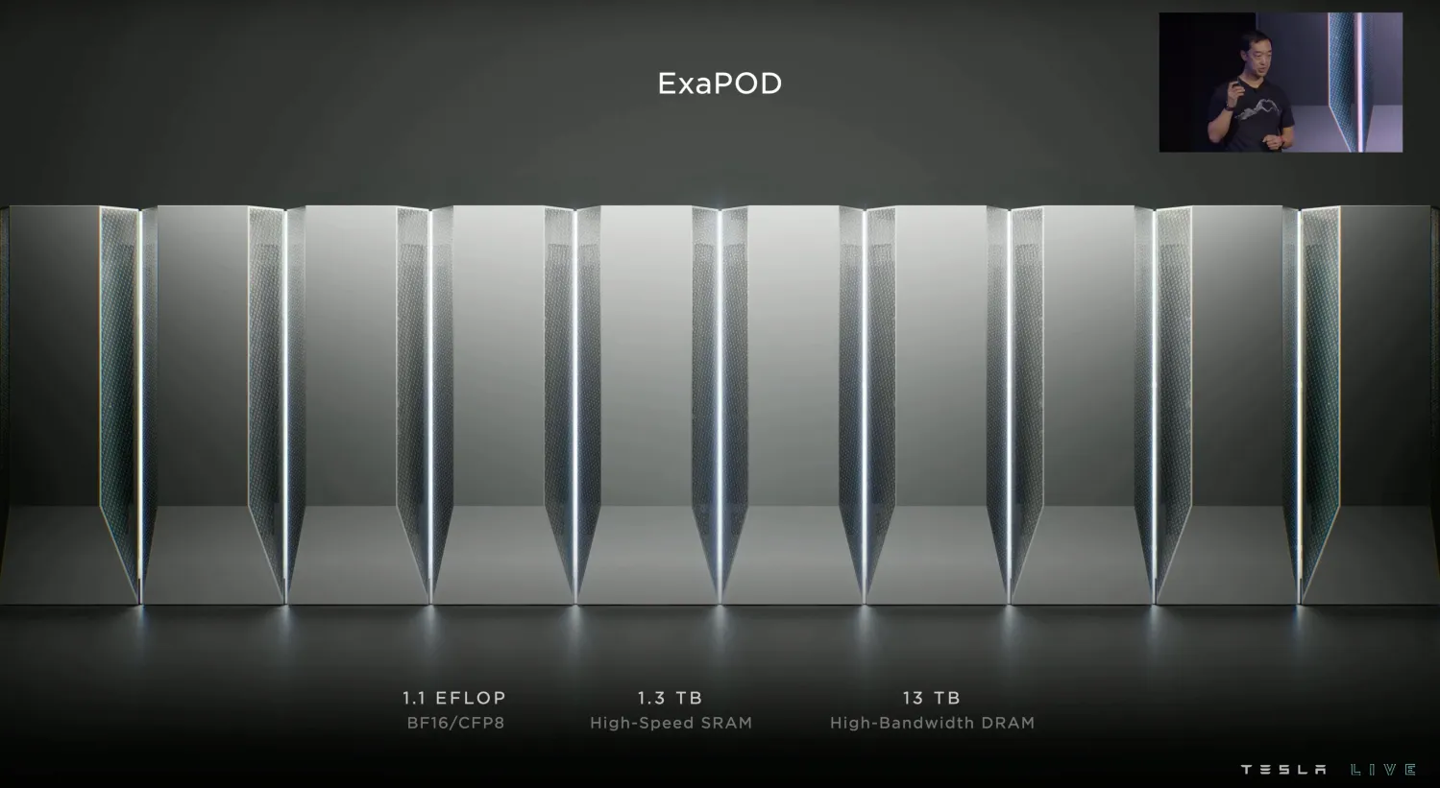
There’s a quiet tension in watching Tesla file a trademark for something called “Megapod” less than a year after the company pulled the plug on Dojo, its once-ambitious in-house AI training supercomputer. The name alone suggests Tesla hasn’t given up on AI infrastructure — it may simply be rethinking how to package it.
According to trademark documents reviewed by Electrek, Tesla submitted an intent-to-use application for “Megapod” (serial number 99893717) to the U.S. Patent and Trademark Office this month, through the same intellectual property law firm it has worked with for years. The filing describes a product that is audaciously comprehensive: a modular data center hardware system purpose-built for artificial intelligence computing, comprising computer servers, AI-specific processing hardware, networking equipment, power distribution units, and cooling systems — all bundled together as a single, integrated platform.
The level of detail in the filing goes well beyond what a typical trademark application includes. Megapod is positioned as an all-in-one, rack-level computing system sold as a complete unit, with integrated compute, power delivery, and thermal management. The application also covers companion software for monitoring, managing, and optimizing the system’s performance. In plain terms: Tesla wants to sell a turnkey AI data center building block — not individual chips, not standalone batteries, but an entire cabinet-scale system capable of handling both AI model training and inference workloads out of the box.
The ambition is clear. The problem is that this market already has an entrenched incumbent, and it isn’t Tesla.
NVIDIA’s GB200 NVL72 is the industry’s current reference design for modular AI compute: a liquid-cooled rack system packing 72 Blackwell-architecture GPUs and 36 Grace CPUs, functioning as a single giant GPU. NVIDIA’s DGX SuperPOD can stack multiple NVL72 racks into clusters scaling past 9,000 GPUs. Dell ships the PowerEdge XE9712 on the same platform, and Supermicro has its own GB200 NVL72-based supercomputing cluster offering. The lane Tesla’s Megapod wants to enter is crowded, mature, and dominated by NVIDIA silicon at every level.
And then there’s the naming problem. Submer, an immersion-cooling company, already sells a product called “MegaPod” — a 40-foot prefabricated immersion-cooled containerized data center rated for up to 800 kilowatts with a power usage effectiveness (PUE) as low as 1.03. Submer has already registered the “MEGAPOD” trademark in relevant goods categories. Tesla’s application falls under computer hardware classifications, so the two may not overlap directly, but the name is neither original nor free of potential trademark disputes.
Whether Megapod signals a real product roadmap or merely a defensive name reservation remains to be seen. But the timing — so soon after Dojo’s shutdown — suggests Tesla is still very much thinking about what it would take to compete in the AI infrastructure game, even if the rules are currently written by someone else.