China's Largest Automotive-Grade Chip Testing Center Launches in Shanghai's Lingang
Shanghai Awinic Electronic Technology has officially cut the ribbon on its “Ink Bottle” automotive-grade experimental testing center in Shanghai’s Lingang New Area, marking the launch of what is now China’s largest testing facility dedicated to automotive-grade chips.
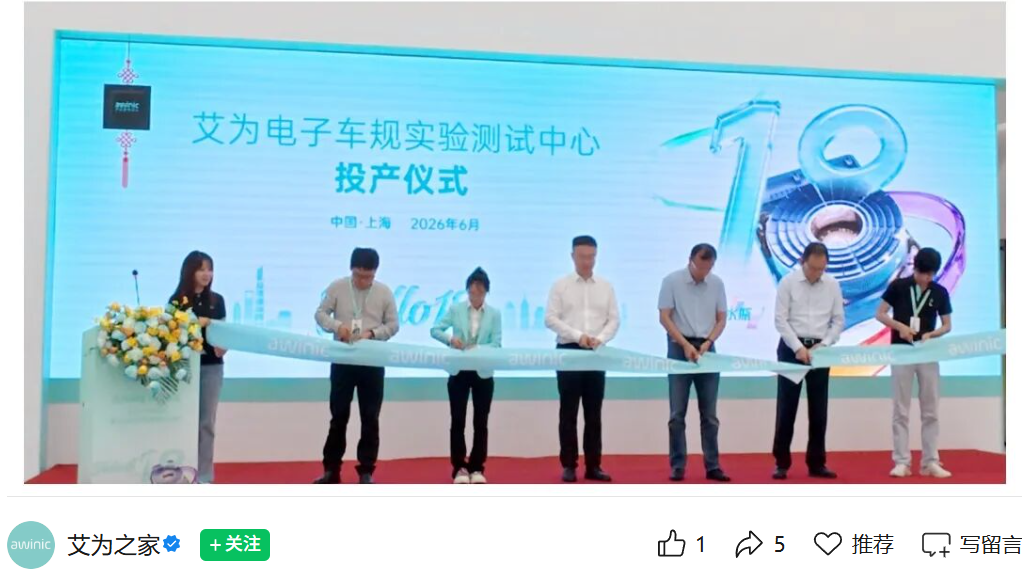
The ceremony was attended by Li Xiangcong, director of the Lingang New Area Management Committee’s High-Tech Division; Weng Wei, party secretary and chairman of Lingang Science and Technology City; alongside Awinic chairman Sun Hongjun and CEO Lou Shengbo.
With a total investment exceeding 9.4 billion yuan (approximately $1.3 billion) and a building footprint of over 110,000 square meters, the center is designed for an annual chip testing throughput of 30 to 50 billion units — a scale unmatched by any other automotive-grade facility in the country.
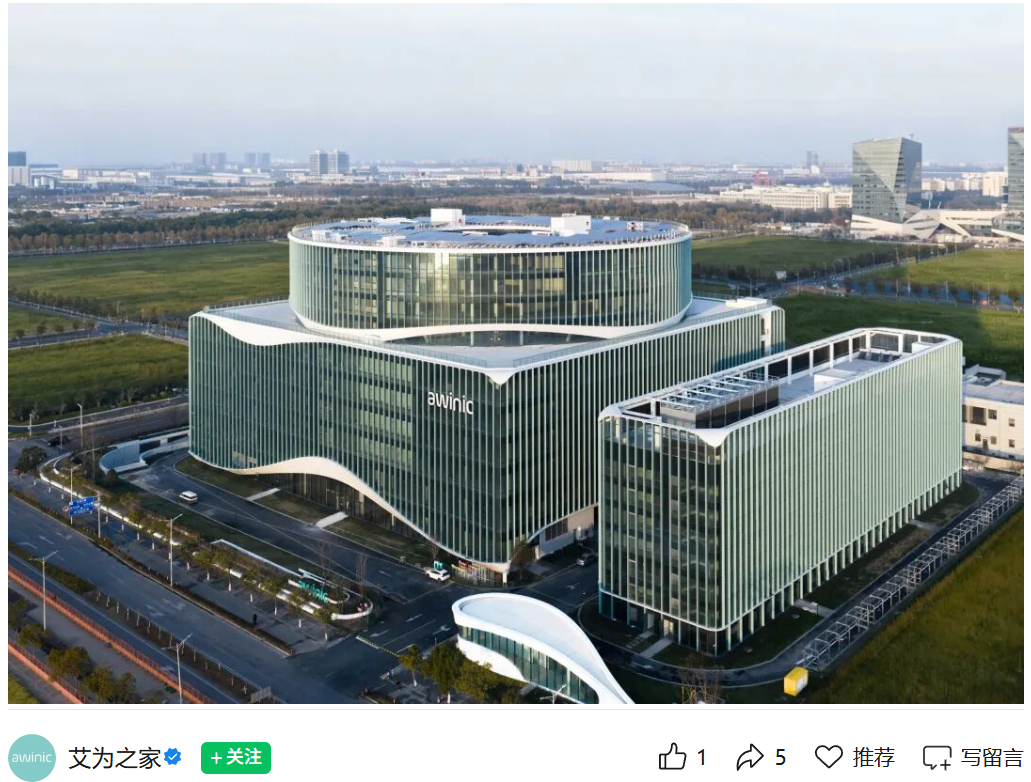
Awinic is already a heavyweight in China’s mixed-signal chip sector, with products spanning consumer electronics, automotive electronics, industrial interconnects, and AI hardware. The testing center — whose distinctive facade earned it the “Ink Bottle” moniker — was designed around the classical Chinese architectural concept of “round heaven, square earth.” The project was first unveiled at the 2023 World Design Cities Conference, completed its main structural work in December 2024, and entered final inspection in May 2026.
The center integrates R&D, experimentation, testing, and exhibition into a single campus, positioned as a fully automated “lights-out” factory and smart manufacturing lighthouse for automotive-grade chip testing.
Industrial-scale hardware meets homegrown tools
On the hardware side, the facility houses a 40,000-square-meter large-scale cleanroom equipped with 450 automotive-grade high-and-low-temperature sorting machines and probe stations, alongside 450 units of high-end chip testing equipment. It also features a rapid packaging pilot line, an SMT pilot line, reliability labs, EMC labs, and failure analysis labs — essentially a one-stop shop for the entire chip verification chain.
Crucially, the production lines are powered by Awinic’s own testing instruments. The AT5000 “Honghu” RF tester and AT6000 “Zhuque” mixed-signal tester are already deployed on the floor, and an automated robotics pilot line has completed commissioning. Mass delivery of the self-developed test equipment is expected by the end of 2026, with full-line batch deployment targeted for 2027 — at which point the entire testing, sorting, and packaging workflow will run unattended around the clock, coordinated through an IoT platform managing over a thousand instruments simultaneously.
The civil engineering team employed a high-precision “three-measure, three-accept” methodology from the ground up to isolate the facility from temperature fluctuations and vibration that could compromise nanometer-scale measurements.
Certifications and cost advantages
The center’s credentials stack up impressively. It earned CNAS laboratory accreditation back in 2022 — among the first chip design firms in China to do so. In 2023, it secured Germany’s TÜV NORD IATF16949 automotive quality certification and SGS ISO 26262 ASIL D, the highest functional safety rating. The facility has also been designated an official “Integrated Circuit Testing and Inspection Service Platform” by the Lingang New Area and recognized by the Shanghai Municipal Commission of Economy and Informatization.
The business case is compelling. Compared to the traditional model of shipping chips overseas for verification, Awinic’s local one-stop service can shorten the certification cycle for automotive companion chips by more than 40% and reduce total per-chip testing costs by over 35%. At full capacity, the facility can absorb testing orders from the vast majority of China’s new-energy vehicle makers, smart cockpit suppliers, and AI chip firms.
Awinic’s expanding footprint
CEO Lou Shengbo revealed that the company filed 164 patent applications in 2025, including 53 key patents — a 40% increase over 2024. The business now spans four core tracks: consumer mobile (deeply integrated into flagship smartphones from major brands), automotive (all five product lines — audio, ambient lighting, RF, haptic motors, and power signal chains — are in volume production for vehicles), industrial IoT (covering humanoid robots, security, medical, home appliances, PCs, and drones), and edge AI, where Awinic has penetrated more than 90% of mainstream AI glasses brands including Meta, ByteDance, and Rokid.
Chairman Sun Hongjun pledged to fully leverage the new base’s capacity, doubling down on automotive-grade and AI chip segments while building an industry-shared, high-end public testing platform — lowering the barrier for China’s domestic chip R&D and certification.
Lingang itself has transformed dramatically: Li Xiangcong noted that the area’s above-scale industrial output has surged from 40 billion yuan in 2018 to 450 billion yuan today, with a complete integrated circuit industry chain and over 160 new-energy vehicle supply-chain enterprises now clustered in the zone.