Chinese Team Develops 'Polymer Lock' Material That Boosts Solar Desalination Efficiency 8.5×
A joint team from the Institute of Process Engineering at the Chinese Academy of Sciences and Shenzhen University has developed a novel polymer “lock” mechanism that dramatically improves solar-driven seawater desalination, potentially offering a lifeline to the quarter of the world’s population facing severe water scarcity.
With the global freshwater deficit projected to hit 40% by 2030, solar-driven interfacial evaporation has emerged as one of the most promising green technologies for producing clean water. The technique’s core challenge lies in the photothermal material itself: nanoparticle powders offer excellent light-to-heat conversion thanks to their large surface area and tunable band structures, but assembling them into durable three-dimensional structures has been a persistent obstacle.
Two problems have stymied progress. First, nanoparticles tend to clump together during assembly, degrading performance and producing weak, expensive structures. Second, photocatalytic effects gradually break down the organic frameworks that hold the material together, causing it to deteriorate over time.

The team took inspiration from a simple button-and-thread lock. They first synthesized multi-layered hollow nanospheres to serve as “buttons,” then used polyester molecular chains — acting like sewing thread — to precisely weave through the nanospheres’ pores, stitching the particles into a robust three-dimensional “nano-forest.” The polymer threads prevent clumping while simultaneously creating efficient water-transport channels.
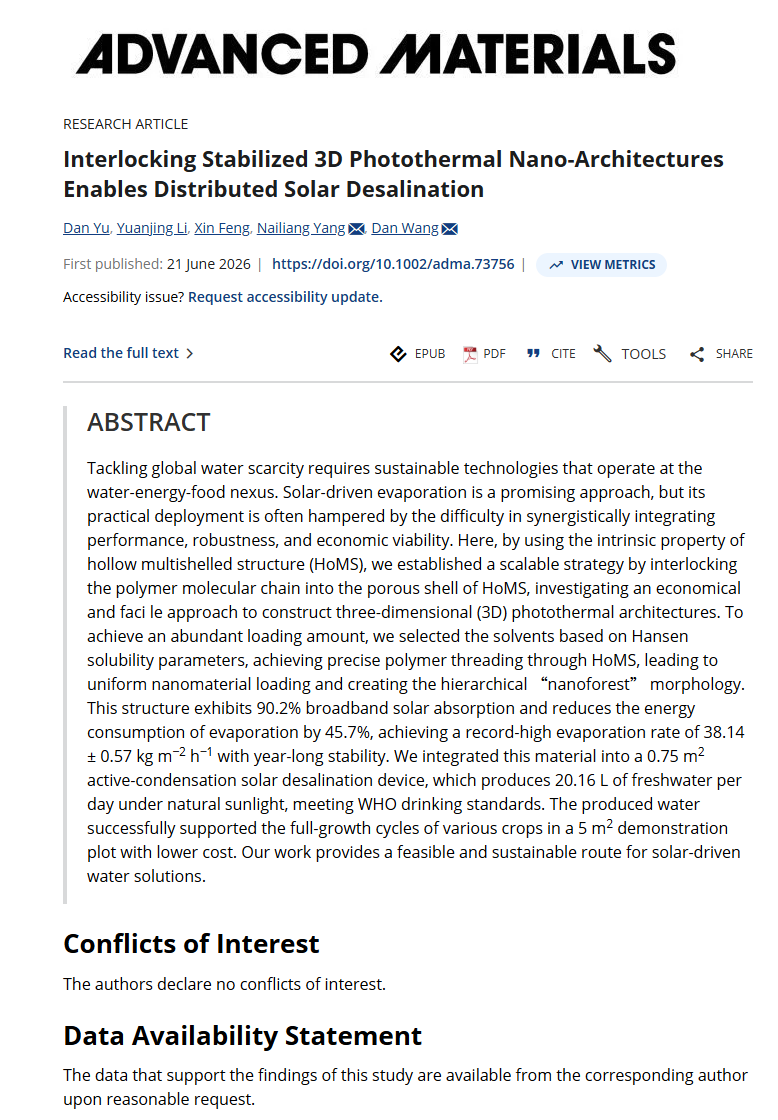
The results, published in the journal Advanced Materials, are striking. The structured material achieves 90.2% solar absorption through multiple scattering and absorption pathways. More remarkably, the nano-confined spaces alter the hydrogen-bond network among water molecules, reducing the energy required for evaporation by 45.7%. A single evaporator unit reached an evaporation rate of 38.14 kilograms per square meter per hour — an 8.5-fold improvement over the team’s previous two-dimensional film.
In a 30-day accelerated seawater aging test, no nanoparticles detached from the structure, and the material generated no reactive free radicals under illumination, solving the organic-matrix degradation problem that had plagued earlier designs.
Under natural sunlight, the device produced 20.16 liters of freshwater per day — enough to meet the basic drinking needs of roughly ten people — with water quality meeting WHO drinking-water standards. The team went further, using the output to irrigate a five-square-meter plot for a full year. Spinach, corn, and bok choy all completed full growth cycles, validating agricultural feasibility. A full-lifecycle cost analysis indicates that after two years of operation, the cost of produced water will fall below that of commercially bottled water.
The research team is now focusing on improving condensation efficiency and reducing system costs, with the goal of deploying the technology at scale in coastal water-scarce regions, islands, and remote areas.